
Адаптивное секвенирование Oxford Nanopore: механизмы, сравнительная эффективность и клиническое значение программно-управляемого таргетного секвенирования
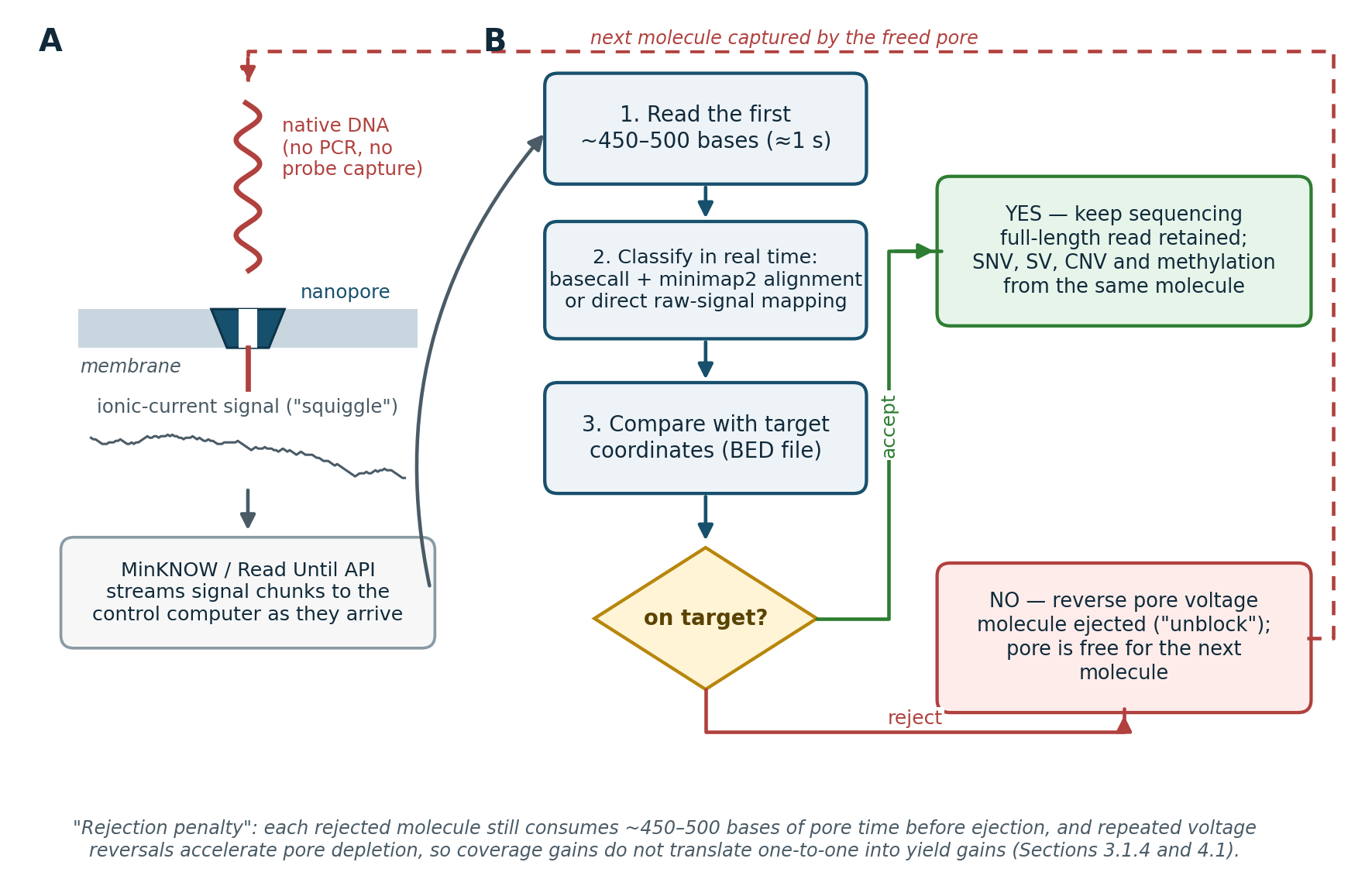
The Adaptive Sampling (Read Until) decision loop
(A) A native DNA molecule translocating through a nanopore generates an ionic-current signal that MinKNOW streams to the control computer in real time; (B) After roughly 450–500 bases (about one second), the partial read is classified, either by real-time basecalling followed by minimap2 alignment or by direct raw-signal mapping, and compared with the target coordinates supplied as a BED file; on-target molecules continue to be sequenced in full; off-target molecules are ejected by reversing the voltage across the pore, which frees it for the next molecule; each rejection nevertheless consumes pore time, which underlies the rejection penalty discussed in Sections 3.1.4 and 4.1. BED, browser extensible data; SNV, single-nucleotide variant; SV, structural variant; CNV, copy-number variant