
Адаптивное секвенирование Oxford Nanopore: механизмы, сравнительная эффективность и клиническое значение программно-управляемого таргетного секвенирования
Адаптивное секвенирование Oxford Nanopore: механизмы, сравнительная эффективность и клиническое значение программно-управляемого таргетного секвенирования

Аннотация
Адаптивный отбор (Adaptive Sampling, AS) представляет собой стратегию обогащения, управляемую программным обеспечением и уникальную для платформы Oxford Nanopore Technologies (ONT), которая обеспечивает выбор мишеней в режиме реального времени посредством динамического изменения напряжения на отдельных нанопорах для удаления немишеневых молекул. В данном обзоре критически оцениваются механизмы, эффективность обогащения и клиническое применение AS в сравнении с ампликонным секвенированием на основе ПЦР и гибридизационным захватом. Согласно результатам сравнительных исследований, AS обеспечивает умеренное обогащение: увеличение глубины покрытия целевых участков примерно в 1,5–4,9 раза и достижение исходного уровня обогащения до 14 раз в метагеномных исследованиях. Однако с учётом потери производительности секвенирования вследствие отбраковки немишеневых прочтений эффективное обогащение снижается примерно до 0,96–4,93 раза, что значительно ниже показателей, обычно достигаемых традиционными методами целевого обогащения на один–три порядка. Поэтому в настоящее время AS менее пригоден для задач, требующих глубокого, равномерного и высокочувствительного секвенирования небольших заранее определённых геномных областей. Основным преимуществом AS является гибкий анализ сложных геномных регионов с использованием длинных прочтений без дополнительной подготовки образцов, включая выявление структурных вариантов, крупных геномных перестроек, фармакогеномных гаплотипов и экспансий повторов, а также одновременное обнаружение SNV, CNV, SV и метилирования ДНК из одной библиотеки нативной ДНК. Целевые регионы также могут быть быстро переопределены посредством изменения файла геномных координат. К основным ограничениям относятся задержка цикла принятия решения, снижение выхода данных с проточной ячейки, ускоренное истощение нанопор, ошибки классификации в повторяющихся регионах и значительные вычислительные требования в режиме реального времени. В целом AS не следует рассматривать как замену традиционным методам целевого обогащения, а скорее как дополнительный подход для комплексной длинночтительной характеристики структурно сложных геномных регионов.
1. Introduction
Third-generation, single-molecule sequencing by Oxford Nanopore Technologies (ONT) measures the disruptions of ionic current that occur as a nucleic-acid strand translocates through a protein nanopore embedded in a synthetic membrane. This sequencing paradigm differs fundamentally from sequencing-by-synthesis approaches, producing reads that routinely span tens of kilobases and can reach megabase lengths in ultra-long sequencing experiments. Furthermore, nanopore sequencing retains native base modifications such as 5-methylcytosine, and streams the raw electrical signal (the "squiggle") in real time, providing unique opportunities for direct epigenetic profiling and adaptive sequencing applications .
A distinctive feature of nanopore sequencing is the ability to make sequencing decisions while an individual molecule is still being analyzed. This capability forms the basis of selective sequencing, whereby molecules can be retained or rejected in real time on the basis of partial sequence information. The first demonstration of this concept, termed "Read Until", was reported by Loose et al. , who showed that the MinION platform could selectively sequence target molecules by reversing the voltage across individual nanopores to eject the non-target strand. In its original implementation, candidate molecules were identified through dynamic time warping (DTW) of the raw electrical signals against a reference sequence.
Adaptive Sampling, introduced as an integrated implementation of Read Until within the MinKNOW software platform in 2020, extends this principle through real-time sequence classification and molecule selection. In enrichment mode, sequencing capacity is preferentially directed towards user-defined regions of interest (ROIs) through the rejection of off-target molecules. In depletion mode, molecules matching predefined sequences, such as host DNA in metagenomic samples, are selectively ejected to enrich the remaining library . The defining feature of the method is that target enrichment is achieved entirely in silico, through software-directed control of individual nanopores, rather than through hybridization or primer-directed amplification. Therefore, AS eliminates the need for target-specific enrichment during library preparation and enables target panels to be modified without redesigning experimental protocols.
Despite rapid uptake, the literature describing AS performance is heterogeneous in both methodology and reporting convention, and vendor-derived performance claims have not always been separated from independent replication. This review therefore evaluates the mechanistic basis of AS and its efficacy against PCR amplicon and hybridization-capture sequencing, summarizes its current and emerging clinical applications, and defines the conditions under which the method is, and is not, an appropriate choice for clinical deployment.
2. Methods
2.1. Scope and sources
This work is a narrative (non-systematic) review. Eligible sources comprised primary studies, benchmarking evaluations, and software tool descriptions reporting quantitative enrichment or read-classification performance for ONT selective sequencing, together with clinical application reports in human genomics, oncology, pharmacogenomics, and infectious disease. The review window opens in 2016 with the first published demonstration of Read Until and closes in 2025. Peer-reviewed publications were preferred throughout. Preprints and technical notes were admitted only where no peer-reviewed equivalent reporting the same measurement was available, and are identified as such at the point of citation and in the reference list.
2.2. Classification of enrichment metrics
Because "fold-enrichment" is reported inconsistently across the AS literature, every quantitative figure extracted for this review was assigned to one of three classes before any comparison was made:
1) coverage-based enrichment, the ratio of on-target read depth obtained with AS to that obtained without it, or to off-target depth within the same run;
2) yield-adjusted enrichment, the same ratio corrected for the total sequencing output lost to read rejection, pore blocking, and accelerated pore decline, which is the metric that determines whether AS delivers more usable target data per flow cell;
3) abundance-ratio enrichment, used in metagenomic studies, the change in the proportional representation of a taxon in the read set.
Figures belonging to different classes are not directly comparable and are never pooled in this review; where a study reports both a coverage-based and a yield-adjusted value, both are given.
2.3. Appraisal of source independence
Each quantitative claim was further labelled as vendor-derived (manufacturer documentation and technical notes, or studies with declared reagent support or industry-affiliated co-authors) or independent. Vendor-derived figures are reported, but always alongside the closest available independent estimate, and conflicts of interest declared by the cited authors are stated at the point of citation.
3. Results and Discussion
3.1. Mechanism of action
3.1.1. The Read Until decision loop
Adaptive Sampling relies on bidirectional communication between the sequencing device and the control software through the Read Until application programming interface (API) . As a DNA molecule translocates through a nanopore, the sequencer continuously sends short segments of raw electrical signal to the control computer. These signals are analyzed either through real-time base calling followed by sequence alignment or through direct signal-based comparison against a reference. Based on this analysis, the system determines whether sufficient information has been obtained to classify the molecule and, if so, whether sequencing should continue or the molecule should be rejected. If the read does not match the target sequence, the voltage across the nanopore is reversed, causing the molecule to be ejected from the pore. This allows the nanopore to immediately capture and sequence a new molecule, thereby increasing sequencing efficiency and enriching the target sequences . The complete decision loop is summarized in Figure 1.
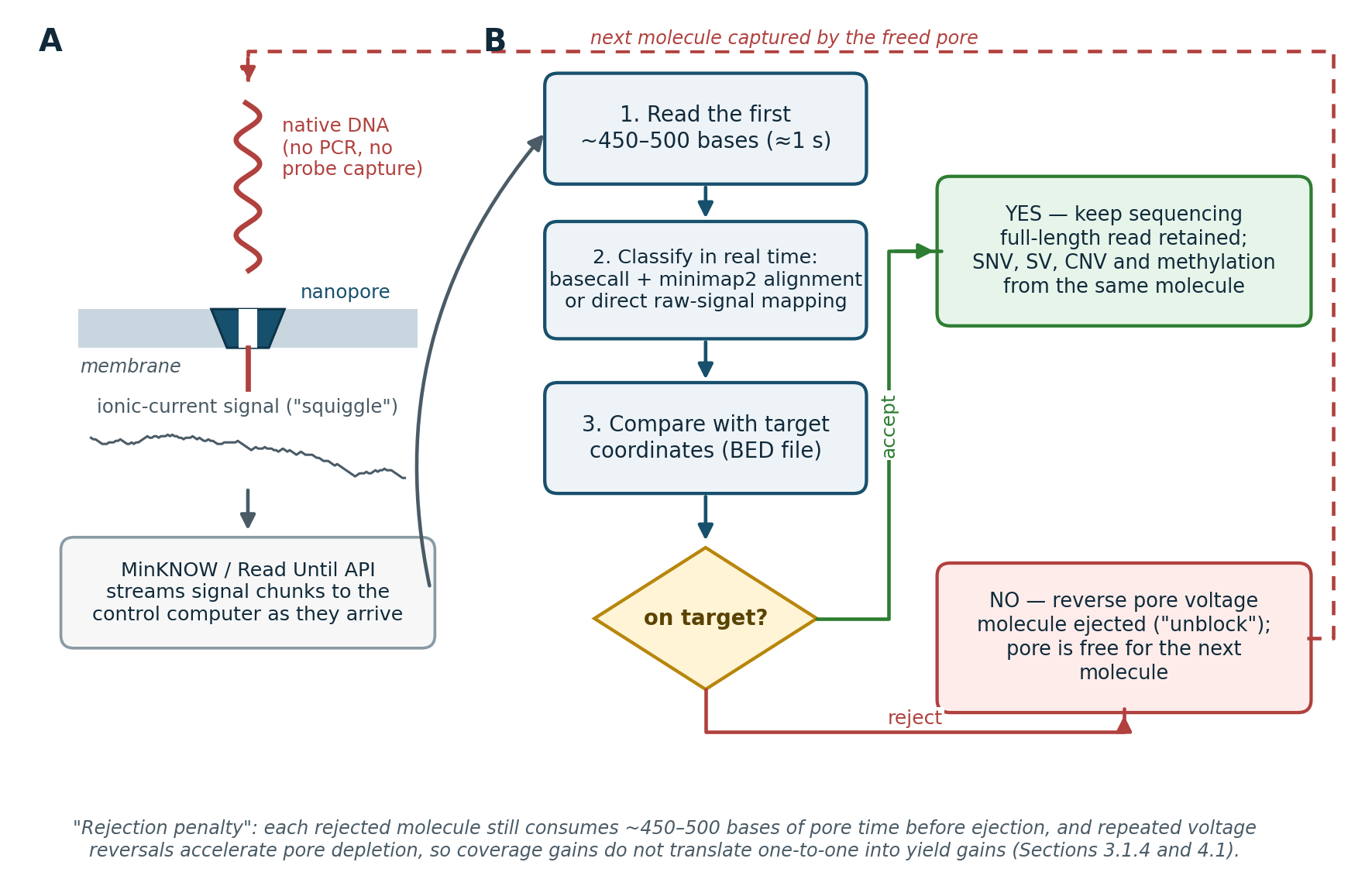
The Adaptive Sampling (Read Until) decision loop
(A) A native DNA molecule translocating through a nanopore generates an ionic-current signal that MinKNOW streams to the control computer in real time; (B) After roughly 450–500 bases (about one second), the partial read is classified, either by real-time basecalling followed by minimap2 alignment or by direct raw-signal mapping, and compared with the target coordinates supplied as a BED file; on-target molecules continue to be sequenced in full; off-target molecules are ejected by reversing the voltage across the pore, which frees it for the next molecule; each rejection nevertheless consumes pore time, which underlies the rejection penalty discussed in Sections 3.1.4 and 4.1. BED, browser extensible data; SNV, single-nucleotide variant; SV, structural variant; CNV, copy-number variant
3.1.2. Real-time alignment and raw-signal mapping strategies
Two main approaches have been developed for real-time read classification in AS. The first approach, implemented in readfish , converts raw nanopore signals into DNA sequences through real-time basecalling and then aligns the sequences to a reference genome using minimap2 , a widely used long-read aligner that locates the genomic origin of a short partial read within milliseconds by matching short sub-sequences ("minimizers") against a pre-built index of the reference. This method works well for large genomes, but basecalling hundreds of partial reads simultaneously within the roughly one-second decision window is computationally demanding and therefore requires a graphics processing unit (GPU), a processor designed for massively parallel arithmetic; without one, real-time basecalling against a gigabase-scale reference cannot keep pace with the sequencer. The original readfish report showed that approximately 360 nucleotides (about 0.8 seconds of sequencing) are sufficient to classify most reads accurately .
The second approach directly compares raw nanopore signals to a reference without performing basecalling. Early signal-mapping methods were constrained by limited scalability and struggled to achieve accurate real-time classification in large and complex genomes. However, methodological advances have substantially improved both computational efficiency and classification accuracy. Tools such as UNCALLED , RawHash , and RawHash2 have improved speed and accuracy. These methods can efficiently identify target sequences and have been successfully applied to both microbial and human genomes. Other tools, including ReadBouncer and SquiggleNet , have also been developed to improve real-time read classification during AS.
3.1.3. Dynamic, data-adaptive strategies
Most Adaptive Sampling implementations rely on predefined target regions that remain fixed throughout a sequencing run. In contrast, BOSS-RUNS introduces a dynamic framework in which sequencing decisions are continuously updated on the basis of data generated during the experiment. Rather than using static target lists, the method quantifies positional uncertainty across the genome in real time and prioritizes sequencing fragments expected to provide the most information. This adaptive decision-making framework allows sequencing effort to be redistributed towards poorly resolved genomic regions as coverage accumulates. In a defined bacterial mixture (the ZymoBIOMICS standard), this approach reduced the number of low-coverage sites of a species present at 1% abundance by 87.5% while detecting 12.5% more single-nucleotide polymorphisms than a comparable non-adaptive run .
3.1.4. The rejection penalty
Although non-target molecules are ultimately excluded from downstream analysis, they nevertheless consume sequencing capacity during signal acquisition, read classification, and execution of the rejection event. In current Adaptive Sampling workflows, classification decisions typically require approximately 450–500 bases of sequence information, corresponding to about one second of sequencing time, before a molecule can be confidently identified as on-target or off-target . This "rejection penalty" means that the efficiency cost of selective sequencing contributes to the reduction in overall sequencing yield frequently observed in AS experiments. Furthermore, repeated voltage reversals have been associated with accelerated nanopore depletion and a progressive decline in the number of active sequencing channels over the course of a run . As a result, improvements in target coverage do not necessarily translate into proportional gains in sequencing efficiency. The distinction between coverage-based and yield-adjusted enrichment defined in Section 2.2 is therefore not a technicality but the central determinant of whether AS delivers a real economic advantage.
3.2. Comparative efficacy against conventional targeted methods
Adaptive sampling differs fundamentally from conventional targeted-sequencing methods in both its mechanism of enrichment and the nature of the resulting sequencing data. The two established paradigms for targeted sequencing differ substantially from AS in their workflow complexity, enrichment efficiency, scalability, genomic coverage, and analytical resolution. Their principal characteristics are summarized in Table 1 and discussed below.
3.2.1. Hybridization (bait) capture
Hybridization capture relies on biotin-labeled oligonucleotide probes that bind target sequences and are subsequently isolated using streptavidin-coated beads. The method offers several advantages, including scalability from targeted panels to whole-exome sequencing, consistent coverage across target regions, minimal background signal, and robust performance in large or complex genomic loci as well as in the detection of novel structural rearrangements . Despite these, its implementation is constrained by a time-consuming, multi-step protocol that commonly incorporates overnight hybridization, a substantial DNA input requirement, elevated reagent and equipment costs, lower on-target efficiency relative to amplicon-based approaches, reliance on fragmented DNA, and the inability to preserve native epigenetic modifications.
3.2.2. PCR amplicon sequencing
Amplicon sequencing enriches predefined targets using locus-specific primers. The approach is characterized by a rapid and relatively simple laboratory workflow, low DNA-input requirements, high on-target efficiency, and the ability to generate deep coverage across selected regions . However, its weaknesses are poor scalability, owing to the combinatorial complexity of multiplexing and primer-dimer formation; amplification bias and chimera formation that can corrupt haplotype reconstruction; poorer coverage uniformity than capture; the destruction of epigenetic information; and a constraint to amplicon-sized fragments.
3.2.3. Adaptive sampling: enrichment magnitude and uniformity
The principal advantage of adaptive sampling lies in its ability to dispense entirely with target-specific enrichment during library preparation. Instead, a conventional genomic library is generated once, while target regions are selected computationally through a coordinate (BED) file that can be modified before sequencing or even dynamically during a run . This design provides exceptional flexibility, favorable single-sample economics, preservation of native base modifications and of full-length molecules (enabling simultaneous single-nucleotide-variant, structural-variant, copy-number-variant, and methylation calling), and avoidance of both PCR and capture bias.
The corresponding trade-off lies in the magnitude and uniformity of enrichment. Whereas amplicon and capture methods routinely deliver hundreds- to thousands-fold on-target enrichment, the enrichment achievable by AS is modest. According to ONT, enrichment of approximately 5- to 10-fold can be achieved when the region of interest (ROI) represents less than 10% of the genome, yielding an average coverage of 20–40× on a MinION flow cell. Applying the appraisal described in Section 2.3, this is a vendor-derived figure, and independent verification tempers it: in a split-flow-cell experiment targeting an ROI comprising 8% of the genome, the adaptive channels yielded 16.96× coverage of the ROI compared with 4.67× for standard sequencing, an enrichment of 3.63-fold . A clinically validated pharmacogenomic workflow developed by a commercial testing laboratory, which multiplexed three samples on one PromethION flow cell, reported a mean enrichment of 8.5-fold (25.2× on-target versus 3.0× off-target) for a panel covering 1.3% of the genome . Similarly, a benchmark study by Yang et al. observed improvements in target coverage ranging from 1.50- to 4.86-fold across six adaptive sampling tools . Studies of metagenomic enrichment by Martin et al. reported raw enrichment of up to 13.87-fold for the least abundant species in the longest-read library . Nevertheless, when sequencing throughput lost through read rejection was taken into account, the effective enrichment across all conditions fell to between 0.96- and 4.93-fold. The gap between these two figures, drawn from the same dataset, is the clearest available illustration of why the metric classification set out in Section 2.2 matters. The reported values are collated in Figure 2.
Coverage uniformity is intermediate and strongly reference-dependent. Performance declines in repetitive and low-complexity regions, where ambiguous early read signals can delay or prevent accurate rejection decisions . In terms of workflow, library preparation is simplest for adaptive sampling and amplicon sequencing, while hybridization capture is the most labor-intensive. Turnaround time similarly favors adaptive sampling and amplicon methods over capture. However, adaptive sampling uniquely requires real-time basecalling and read classification, typically with GPU support, resulting in higher computational demands than the other approaches.
Comparison of adaptive sampling with conventional targeted-sequencing methods
HMW, high-molecular-weight; HW, hardware. Values are indicative and vary with sample type, read length, and reference composition (see Sections 3.2.3 and 4.2)
Attribute | Adaptive Sampling | PCR Amplicon | Hybridization Capture |
On-target enrichment | Modest (~1.5–5× yield-adjusted; 3.6–10× coverage) | Very high (hundreds–thousands-fold) | High (hundreds-fold) |
Coverage uniformity | Intermediate; reference-dependent | Lower than capture; amplification bias | Excellent |
Target-specific library prep | None (BED file only) | Locus-specific primers | Biotinylated probe panel |
Turnaround | Hours to days | Short | Long (overnight hybridization) |
DNA input | Moderate–high (HMW required) | Lowest | High |
Structural-variant resolution | Excellent (long native reads) | Poor (amplicon-sized) | Good for large/novel events |
Native base modifications | Preserved | Erased | Erased |
Re-targeting flexibility | Immediate (edit BED file) | New primers required | New probes required |
Computational/HW overhead | High (real-time GPU) | Low | Low–moderate |
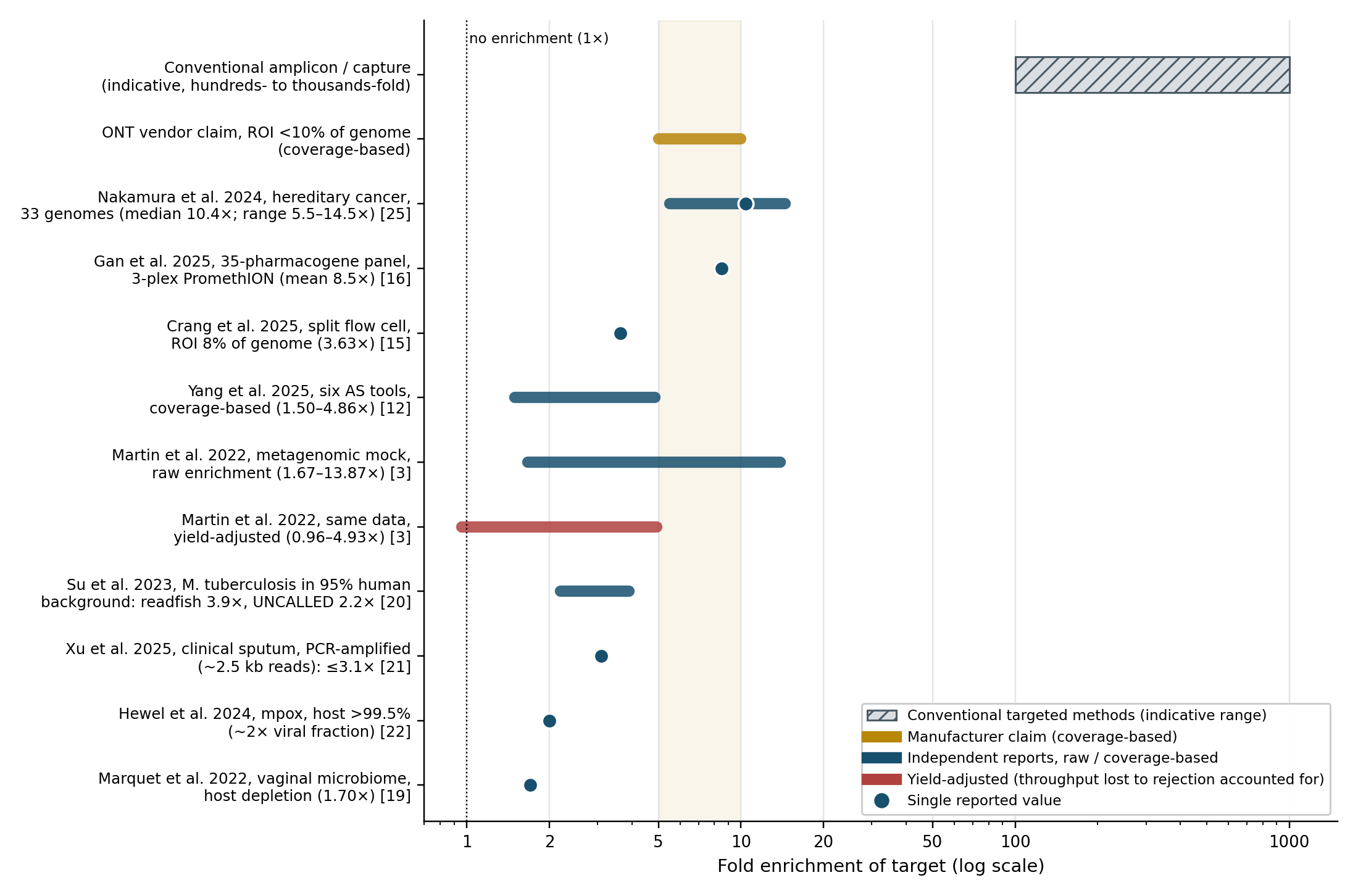
Reported target enrichment achieved by Adaptive Sampling compared with the indicative range of conventional targeted enrichment
bars show reported ranges and circles single reported values on a logarithmic scale; the shaded band marks the manufacturer's 5- to 10-fold claim; the two entries for Martin et al. [3] derive from the same dataset and illustrate the difference between raw (coverage-based) and yield-adjusted enrichment defined in Section 2.2; the range shown for conventional amplicon and capture methods is indicative only (Section 3.2.3); values are taken from the sources cited in Sections 3.2.3, 3.3 and 3.4; bracketed numbers refer to the reference list
3.3. Clinical application: infectious disease and metagenomics
Depletion-mode AS is conceptually well-suited to clinical metagenomics applications, where host-derived nucleic acid typically dominates the sequencing libraries. In untreated respiratory specimens, host reads account for approximately 94.1% of sequences from nasal swabs, 99.2% from sputum, and 99.7% from bronchoalveolar lavage samples , while nasopharyngeal swabs may contain more than 99.9% host-derived reads . By depleting host reads in silico, AS enriches the pathogen fraction without requiring additional laboratory-based host-depletion procedures such as differential-lysis or enzymatic host-depletion chemistries.
The magnitude of enrichment achieved by adaptive sampling is generally modest and highly dependent on sample composition. Marquet et al. reported a 1.70-fold (±0.27) increase in microbial sequencing depth following depletion of human reads, while maintaining the taxonomic structure of the microbial community . However, the complete elimination of host-derived sequences remains unattainable, resulting in residual human genomic data with potential ethical and consent-related implications. Similarly, in a study of Mycobacterium tuberculosis detection from samples containing approximately 95% human DNA, Su et al. compared AS with amplicon-based enrichment strategies . The adaptive-sampling tools readfish and UNCALLED achieved 3.9-fold and 2.2-fold target enrichment, respectively, generating approximately 9× genome coverage of M. tuberculosis. This level of coverage was sufficient for variant detection and antimicrobial resistance (AMR) profiling. Nevertheless, amplicon sequencing produced higher target abundance when the genomic region of interest was known a priori.
A recurring practical limitation in clinical metagenomic workflows is that low DNA yields frequently necessitate PCR amplification. Because adaptive sampling operates most effectively on long native DNA molecules, PCR-induced fragmentation can substantially reduce enrichment efficiency. This constraint was quantified directly by Xu et al., who evaluated AS on clinical sputum using current R10.4.1 chemistry and achieved at best 3.1-fold enrichment of bacterial sequence output, attributing the shortfall to the short (~2.5 kb) read lengths imposed by the PCR amplification required to compensate for low extraction yields; the same study reported rapid pore loss that reduced total sequencing yield by an estimated 80% .
One of the principal advantages of adaptive sampling in infectious disease genomics lies in its ability to preserve long-read information, enabling characterization of genomic context, structural variation, and AMR gene architecture. In a clinical monkeypox virus (mpox) case, Hewel et al. demonstrated that adaptive host depletion increased the proportion of viral reads by approximately two-fold despite host DNA comprising more than 99.5% of the sequencing library . Importantly, long-read sequencing enabled the identification of two structural variants affecting the OPG015 and OPG208 loci that were not resolved using short-read approaches. Collectively, these findings suggest that adaptive sampling is a valuable library-free host-depletion strategy for clinical metagenomics. However, the enrichment factors typically remain within the single-digit range and generally do not match the sensitivity achievable with dedicated laboratory-based host-depletion methods or targeted amplification approaches.
3.4. Clinical application: human genomics and oncology
AS is particularly valuable in clinical genomic applications where conventional short-read sequencing is limited by its inability to fully resolve structural variation, repetitive genomic regions, haplotype structure, or epigenetic modifications.
3.4.1. Structural variants and hereditary cancer
Several studies have demonstrated the utility of adaptive sampling for the characterization of pathogenic structural variants. Miller et al. provided an early clinical demonstration, applying AS-based targeted long-read sequencing to 40 individuals, 10 of whom lacked a complete molecular diagnosis after conventional testing, and showing that a single data source could detect single-nucleotide variants, copy-number changes, repeat expansions and methylation differences, resolve complex rearrangements, and identify pathogenic variants that short-read testing had missed . In hereditary cancer, Filser et al. used AS to characterize a BRCA1 exonic duplication of uncertain significance. Conventional testing had shown only that a segment of the gene was present in extra copies, without revealing where the extra copy lay or whether it disrupted the gene. Long reads spanning the entire event showed that the duplicated segment sat directly next to the original copy (a tandem duplication), and that its two breakpoints fell within two Alu repeat elements sharing 74% sequence identity, a configuration typical of rearrangements mediated by recombination between homologous repeats. Because the extra exons were inserted in tandem, the reading frame of the transcript was shifted, creating a premature stop codon and a truncated, non-functional protein; the variant was therefore reclassified as pathogenic . Notably, the complete analysis was achieved within approximately 10 days, compared with the substantially longer turnaround required for conventional complementary-DNA-based workflows.
Expanding this approach, Nakamura et al. applied target-adaptive sampling long-read sequencing across 33 hereditary-cancer genomes and achieved a median on-target enrichment of 10.4-fold (range, 5.5–14.5) and a median on-target depth of 21.9× (on-target read N50, approximately 9.2 kb) . Beyond the detection of conventional sequence variants, the method identified pathogenic SVA retrotransposon insertions in APC and allele-specific promoter hypermethylation of MLH1, highlighting the ability of nanopore sequencing to simultaneously interrogate genetic and epigenetic alterations.
Similarly, Chevrier et al. sequenced 152 cancer-predisposition genes across 30 germline samples using R10.4.1 nanopore chemistry . The approach successfully detected all 11 large-scale rearrangements, refined a BRCA1 exon-13 duplication detected by multiplex ligation-dependent probe amplification (MLPA) into a tandem exon-12/13 duplication, and resolved a reported "total deletion" into an approximately 140-kb multigene deletion, while detecting all pathogenic single-nucleotide variants at coverage of at least 10×, with six novel variants confirmed by Sanger sequencing. Applying the independence appraisal of Section 2.3, it should be noted that Chevrier et al. received reagent support from ONT and included industry-affiliated co-authors, representing a potential conflict of interest. Collectively, these studies demonstrate that adaptive sampling can provide clinically relevant structural and sequence-level information that is often difficult to obtain using short-read sequencing alone.
3.4.2. Gene fusions and copy-number variation
The foundational readfish study identified PML–RARA fusions, the driver lesion of acute promyelocytic leukemia, in the NB4 cell line within 15 hours of sequencing . The potential clinical utility of this approach was further demonstrated by the Rapid-CNS² workflow developed by Patel et al. in central-nervous-system (CNS) tumors . Using readfish-mediated adaptive sampling during a single MinION sequencing run, the workflow simultaneously generated data suitable for copy-number profiling, structural-variant detection, targeted mutation analysis, and methylation-based tumor classification without additional library preparation. The authors reported copy-number profiles in complete concordance with EPIC methylation arrays, approximately 94% concordance for pathognomonic mutations, correct MGMT promoter-methylation status in all samples, and methylation-family classification, with a turnaround of approximately four days that was reducible to under 12 hours by adjusting the size of the target panel.
3.4.3. Repeat-expansion disorders
Repeat-expansion disorders represent a particularly attractive application of adaptive sampling because pathogenic repeat loci are often refractory to comprehensive characterization by short-read sequencing. Stevanovski et al. applied the ONT Read Until technology for the parallel genotyping of all known neuropathogenic short tandem repeats in a single assay . The approach enabled haplotype-resolved assembly and methylation profiling across multiple repeat-expansion disorders and correctly diagnosed 37 individuals (including 25 disease cases). Independently, Miyatake et al. applied AS on a GridION to 59 repeat-expansion loci (0.2% of the genome) in 22 patients, obtaining a mean depth of 24.7× with relatively uniform coverage across loci, confirming the expanded repeat in all 12 previously diagnosed patients, and correcting two diagnoses that had been made by conventional PCR-based methods; the authors recommended a minimum on-target depth of 10–15× to separate the two alleles reliably . Importantly, unlike Cas9-mediated targeted sequencing approaches such as nCATS [29], adaptive sampling requires no locus-specific guide RNAs, allowing target panels to be modified computationally without redesigning laboratory workflows. This flexibility is particularly advantageous in a rapidly evolving field where novel pathogenic repeat loci continue to be discovered.
3.4.4. Pharmacogenomics
Pharmacogenomic loci frequently present analytical challenges because of sequence homology, structural variation, and complex haplotype architecture. The pharmacogene CYP2D6 is a notable example, being notoriously difficult to characterize owing to its high homology with the CYP2D7 and CYP2D8 pseudogenes, as well as its structural and copy-number variation. Long-read sequencing has previously been shown to resolve complete CYP2D6 haplotypes and gene duplications , capabilities that are often difficult to achieve using conventional short-read or array-based approaches. AS extends this capability to multi-gene panels without the need for per-locus primer design. Deserranno et al. enriched 1,036 PharmGKB pharmacogenes by AS and demonstrated accurate variant and star-allele calling against Genome in a Bottle reference materials, capturing structural variants and achieving unambiguous haplotype phasing of a kind unavailable to microarray, PCR, and short-read assays . A subsequent re-analysis of the same data with updated basecalling, phasing, and star-allele-calling tools resolved the CYP2D6 diplotypes that had initially remained ambiguous and matched a commercial long-read capture panel for every Clinical Pharmacogenetics Implementation Consortium (CPIC) level-A gene, while yielding about three times more variants per phasing block . Clinical translation has since been demonstrated by Gan et al., who validated a 35-pharmacogene AS assay across 17 reference and clinical samples, reporting 99.9% concordance for small variants, more than 95% for structural variants, and 97.7% and 98.0% concordance for phased diplotypes and metabolizer phenotypes, respectively, with improved calls in 12 genes attributable to better phasing or the detection of novel alleles .
3.5. Synthesis: method selection by clinical question
Taken together, the evidence above supports a nuanced rather than a triumphalist appraisal of AS. The method should be understood not as a universal replacement for established enrichment chemistries but as a complementary tool whose value is concentrated in a specific and clinically important niche: the resolution of structurally complex genomic loci from native, full-length molecules.
AS is the preferred modality when the clinical question requires base-pair resolution of structural variants or large rearrangements, full-gene haplotyping and phasing, the preservation of native methylation, single-sample or rapidly re-configurable panels, or the combined detection of single-nucleotide, structural, copy-number, and methylation variation from a single run. As a practical threshold, the sample should comprise high-molecular-weight DNA with a library N50 of at least approximately 8–10 kb, and the target footprint should occupy less than approximately 10% of the genome, so as to preserve the 5- to 10-fold enrichment regime described by the manufacturer, recognizing that approximately 3.6-fold may be a more realistic expectation under conservative independent testing .
Amplicon sequencing remains preferable for the deep, sensitive interrogation of small, predefined hotspot targets, for low-input or degraded samples, and where turnaround time and per-sample cost are paramount. Hybridization capture remains preferable for large, fixed panels or exomes that require high coverage uniformity across many samples processed in batch.
3.6. Validation prior to clinical deployment
Before AS is adopted in an accredited setting, several validation steps are advisable. The method should be benchmarked on a split-flow-cell design against a non-adaptive control in order to measure the yield-adjusted enrichment for the specific target and sample matrix in question, coverage-only fold figures should not be relied upon , . In metagenomic applications, AS depletion should be paired with an orthogonal wet-laboratory host-depletion step where sensitivity is limiting, given that AS alone delivered only 1.7- to 3.9-fold enrichment in published clinical work , . Finally, minimum-coverage variant-confidence thresholds should be established, for example at least 10× with appropriate quality filtering, following Chevrier et al. and novel or clinically critical calls should be confirmed by an orthogonal method, such as Sanger sequencing or MLPA, during accreditation.
3.7. Emerging developments and triggers for reassessment
Several developments are likely to mitigate the constraints described in Section 4.1. These include dynamic Bayesian sampling strategies ; direct-RNA AS so far limited to 1.9-fold enrichment for direct RNA versus 1.3-fold for complementary DNA, reflecting the slower translocation of RNA (approximately 260 bases per second, versus approximately 400 bases per second for cDNA) ; barcode-aware multiplexed AS at PromethION scale ; and faster, more accurate R10.4.1 chemistries that shorten the decision loop.
The recommendations above are contingent on the current performance envelope of the technology and should be revisited as it matures. Three developments in particular would materially change the calculus. First, if decision-loop latency falls substantially to the point of sub-300-base rejection and the pore-longevity penalty is eliminated by new chemistry or hardware, the yield-adjusted enrichment of AS could approach that of capture, extending its use to coverage-limited diagnostics. Second, if raw-signal mappers and in-memory or accelerator hardware remove the real-time GPU requirement , , the economics of AS would improve for decentralized and point-of-care settings. Third, as validated multiplexed, barcode-aware AS matures , the per-sample cost would fall, and the batch use cases that are presently the domain of capture would become competitive.
4. Limitations
Two categories of limitation bear on the conclusions of this review: constraints intrinsic to the technology, and constraints on the evidence base from which its performance has been estimated.
4.1. Technical limitations of adaptive sampling
Every rejection carries a fixed cost, because several hundred bases must be sequenced before a molecule can be classified: most tools eject reads at approximately 478–576 bp (1.1–1.3 seconds), and UNCALLED at an average of 1,443 bp (3.2 seconds) . Efficiency therefore scales with molecule length, ranging in one metagenomic series from 1.67-fold for the most abundant species at 1.7-kb mean read length to 13.87-fold for the least abundant at 12.8 kb, with yield-adjusted efficiency falling to approximately 0.96-fold (no net benefit) at the unfavorable end . High-molecular-weight DNA is thus a prerequisite, which restricts application to degraded, formalin-fixed paraffin-embedded, and amplification-dependent material . Repeated unblocking compounds the problem by reducing total yield and accelerating pore decline : enrichment of 5- to 7-fold has been reported alongside a fall in overall throughput , and severe pore loss has caused outright run failure in clinical workflows . Fold-enrichment must therefore always be read against reduced absolute yield and shortened run life.
Accuracy and infrastructure impose further limits. minimap2-based depletion failed to reject approximately 25% of human reads in one study , repetitive and low-complexity regions delay or prevent correct rejection , and the residual host sequence surviving depletion raises consent and data-governance concerns. Real-time GPU basecalling against gigabase-scale references also demands hardware that is not universally available, partly offsetting the preparation-free economy of the method, although raw-signal mappers and pre-basecalling filters aim to relax this requirement.
4.2. Limitations of the evidence base
This is a narrative rather than a systematic review: sources were not screened against a pre-registered protocol, no risk-of-bias instrument was applied, and no quantitative synthesis was attempted, so selection bias towards frequently cited and positive reports cannot be excluded. The principal substantive constraint is that enrichment figures are not directly comparable across studies — "fold-enrichment" may denote a coverage ratio, a yield-adjusted efficiency, or an abundance ratio (Section 2.2), and published values span approximately 1.5- to 13.9-fold raw against 0.96- to 4.93-fold yield-adjusted , . Vendor and independent data also diverge, the manufacturer's 5- to 10-fold claim contrasting with 3.63-fold on independent split-flow-cell testing , and several prominent clinical studies received ONT reagent support or included industry-affiliated authors , and the largest clinical pharmacogenomic validation to date was performed by a commercial testing laboratory .
Several quantitative claims further rest on single studies or on specific chemistries (R9.4 versus R10.4.1) and may not generalize, since performance depends strongly on sample type, read length, and reference composition. The field also moves quickly, and the latency, accuracy, and pore-longevity figures cited here reflect reports from 2016 to 2025 that are likely to improve. One corroborating source is a preprint rather than a peer-reviewed article and is identified as such in the reference list; all others are peer-reviewed.
5. Conclusion
Adaptive Sampling represents a genuine conceptual advance: it is the first enrichment method to be implemented in software rather than in chemistry, and it uniquely preserves the long-range and epigenetic information that distinguishes nanopore sequencing. Its enrichment is, however, modest and is materially eroded by the throughput cost of read rejection, such that it cannot at present match amplicon or hybridization-capture sequencing for deep, uniform interrogation of small, predefined targets. The clinical trajectory of the technology is therefore unlikely to be one of wholesale displacement of conventional methods. Rather, AS is consolidating its role as a complementary, preparation-free modality for structurally complex clinical genomics such as hereditary-cancer rearrangement characterization, CNS-tumor molecular profiling, repeat-expansion genotyping, and pharmacogenomic haplotyping, where its ability to resolve, from a single native library, what other targeted methods cannot is of decisive value. Continued reductions in decision-loop latency, improvements in pore longevity, and the maturation of multiplexed protocols will determine how far beyond this niche the method ultimately extends.